Unlocking the Power of Followership by Dr Gerri Khong
Dr Gerri Khong2 min read

“Effective followers and effective leaders are often the same people playing different parts at different hours of the day”.
— Robert Kelley, The Power of Followership
The role of good followership is often overshadowed by an emphasis on leadership. A PubMed literature search in 2019 demonstrated over 57 000 articles on leadership and less than 100 on followership - a ratio of 600:1.
We spend a significant amount of time on developing leadership skills in comparison to the time spent developing our followership skills, especially as most of us spend more time as followers than leaders in both clinical and non-clinical situations.
The success of a high performing team is a function of both good leadership as well as good followership. Although leadership is important in achieving a goal the effectiveness of the team members is critical. Leadership and followership is a supportive relationship. It is worthwhile to ask yourself the following questions:
Can poor leadership be overcome by good followership?
Can poor followership be overcome by good leadership?
My top observations of what makes a good follower? Good followers are:
Egoless
They take a step back and recognise that although they could be the leader, they don’t need to be the leader. Leaders who are able to also work in a team as a follower provide incredibly strong role modelling for other team members.
Supportive
They support other team members as well as the leader. The best team members are able to perform their role whilst also maintaining a level of situational awareness. This is demonstrated in back-up behaviours and mutual performance monitoring.
Assertive
They know when and how to speak up and when to remain silent. They have the courage to challenge a leader who risks the values and objectives of the team. This concept of the “Assertive Follower” is reflected in this image:
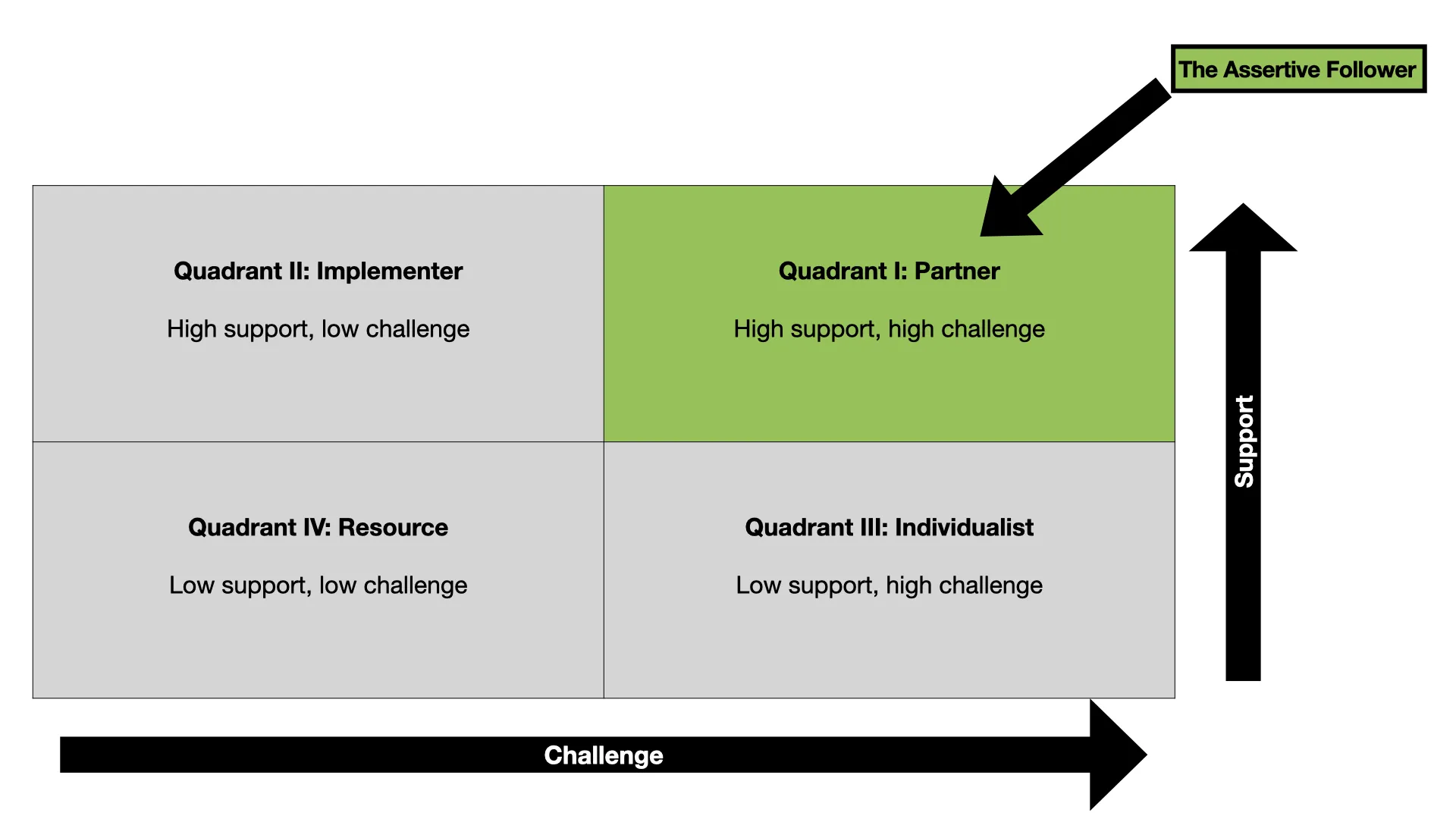
Adapted from Ira Chaleff’s ‘The Courageous Follower’
Accountable
They are engaged and committed to create an effective team and achieve the outcome required. They have a high level of personal responsibility in their own behaviour and how it affects the team.
Collaborative
They have a high level of interpersonal and listening skills. They are able to voice concerns and disagreements in a mutually respectful manner. They realise that their actions affect the whole team.

Dr. Gerri Khong is an Anaesthetist at Royal North Shore Hospital, a Staff Specialist at the Sydney Clinical Skills and Simulation Centre and the Emergency Management of Anaesthetic Crises (EMAC) Supervisor for NSW. She has an interest in Simulation and Human Factors.